/
8 mins read
TL;DR
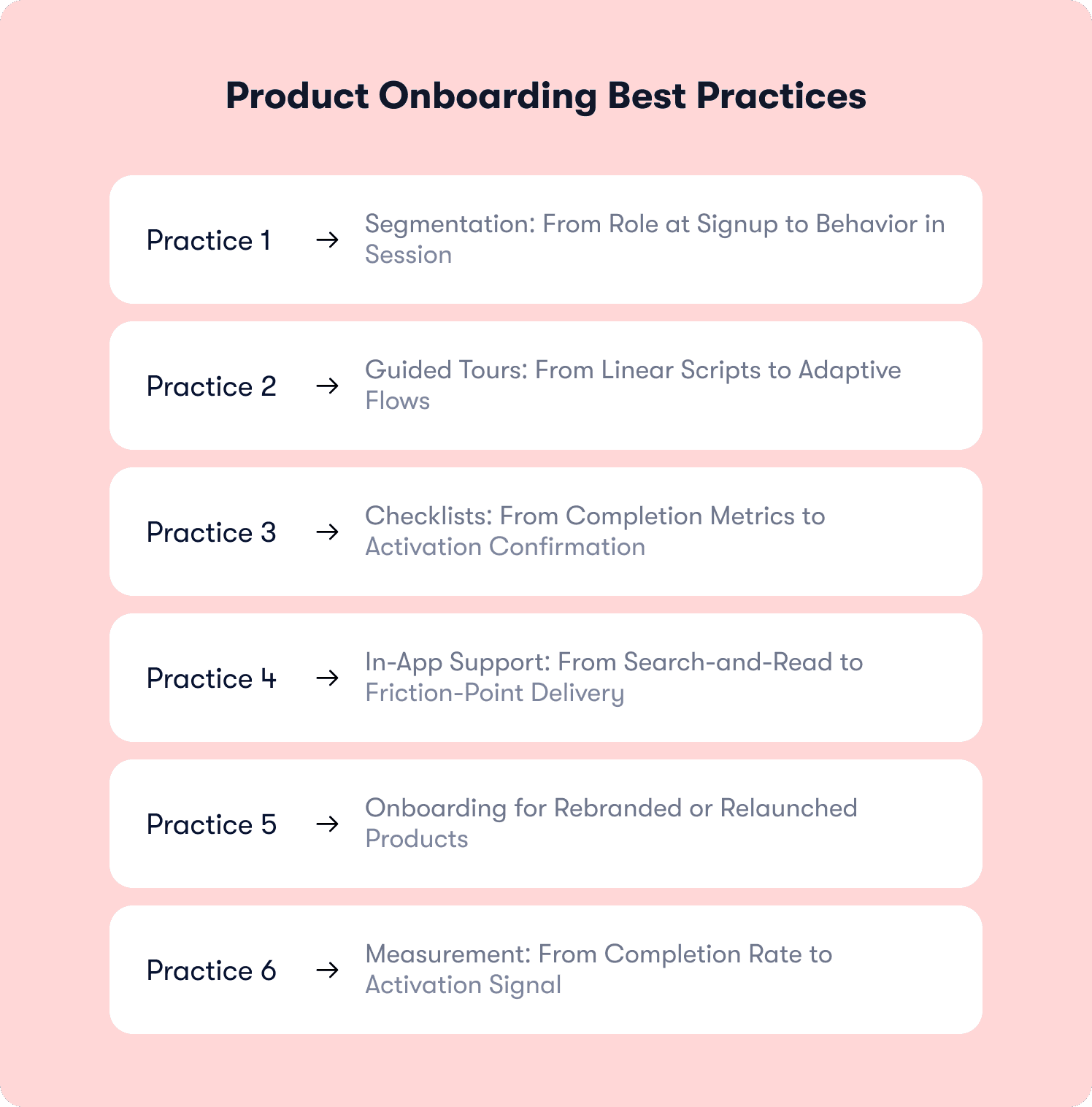
Most SaaS teams have onboarding that works, in the sense that it exists and produces some activation — but it was built for a user who no longer exists at the standard AI-native products have set. This article audits six practices your team is likely already running and shows exactly where each one breaks in 2026: role-based segmentation that decays within weeks of signup; linear tours that assume a path users stopped following; checklists that reward clicking rather than doing; help centers that ask users to leave the product at the moment they most need to stay; rebrand communications that miss users at the actual point of confusion; and completion-rate measurement that tells you nothing about revenue outcomes. For each practice, there is a named upgrade (behavioral segmentation, adaptive flows, action-gated checklists, friction-point delivery, encounter-triggered re-onboarding, and activation-rate tracking) and none of them requires an engineering sprint to execute.
You already have onboarding. You have tours, checklists, a resource center, and probably a drop-off report you review every quarter. The question is not whether you built something. The real test is whether what you built still holds up in a market where AI-native products have moved the baseline for what users expect in their first hour.
The standard has shifted. Products like Cursor and Gamma do not guide users through onboarding. They adapt to what users do in real time, surface the next right action before the user knows they need it, and reach value in under 60 seconds. It is the current benchmark which is set by products your users already use daily.
When those users open your product, they carry that expectation in. They do not lower their tolerance for friction because your stack is older or your team is smaller. They leave. Your churn data picks it up 30 days later, which is long after the decision was made.
This article is not a primer on building your first onboarding program. It is an audit of six practices that most SaaS teams already run, and a precise account of where each one breaks against the 2026 standard and what the upgraded version looks like in practice. If your activation rate is not moving despite a working onboarding program, at least one of these six gaps is the reason.
What "Best Practice" Means in 2026
The ProductLed WARP framework puts a number on it: 60 seconds to value. Not 60 seconds to the end of a tour. 60 seconds to the moment the product does something meaningful for the user: a first report generated, a first connection made, a first workflow completed. That bar was aspirational two years ago. AI-native products have made it routine, which means it is now what users expect from every product they open.
The fastest-growing SaaS companies of the past two years did not improve their onboarding. They replaced the concept. Instead of guiding users through a scripted flow, they built products that observe what users do and respond with the next right action: contextually, immediately, and without requiring users to follow a predetermined path. The flow is not designed in advance. It is inferred from behavior.
That shift has a direct consequence for teams running traditional onboarding programs. Every practice built around a predictable user path is now working against you. Not because the practice was wrong when it was designed, but because the user it was designed for has changed. They are faster, less patient, and shaped by products that do not ask them to sit through a tour before they can do anything.
What follows is what each practice looks like when it is rebuilt for that user.
Your Activation Rate Is Hidden Inside User Behavior
Most onboarding teams already have tours, checklists, and onboarding flows in production. The problem is that many of those systems optimize for completion instead of behavior change.
If you are redesigning onboarding around activation instead of clicks, we compiled 19 SaaS activation tactics used by high-performing product teams across PLG, hybrid, and enterprise onboarding models.
Best Practice #1 — Segmentation: From Role at Signup to Behavior in Session
Role-based segmentation at signup was the right call when it was introduced. Routing a user who identified as an administrator to an integration setup flow, and routing an end user to a workflow tour, was a meaningful improvement over sending every new signup through the same experience.
Where it breaks today:
Role self-selection at signup decays within one to three weeks as users go deeper into actual workflows: their needs shift, but the segment logic does not
Static segments surface guidance built for a profile that no longer matches what the user is doing
Maintaining accurate segment rules requires manual PM effort that is almost never prioritized until activation data flags a problem, months too late
The 2026 upgrade:
Route users based on what they are doing: which features they have touched, where they have stalled, and what actions correlate with activation in their cohort
Segment logic updates from behavior automatically, without requiring engineering to rewrite routing rules every time the product or user base changes
Guidance matches the user's current context, not the context they reported on the day they signed up
Jimo's analytics segments connect behavioral data directly to guidance delivery without manual routing updates. Crossbeam implemented this approach for their action-driving in-product banners and saw 3x click-through rates over their previous role-based flows, a difference that came from matching the message to the user's current state rather than their signup self-description.
Best Practice #2 — Guided Tours: From Linear Scripts to Adaptive Flows
Linear product tours were built for a linear user. The logic was defensible: users are new, they do not know the product, so walk them through it in a fixed sequence that ends at the activation event. For products where most users moved through the same workflow in the same order, this worked reasonably well.
Where it breaks today:
Users explore features before completing setup, skip steps that do not match their immediate goal, and return days later with a different objective than the one they started with
When a user returns to a product mid-tour, they encounter guidance built for a session state they left behind; the tour is now friction, not a guide
Drop-off mid-tour is common not because users are disengaged but because the sequence no longer matches where they are
The 2026 upgrade:
Flow logic responds to what the user has actually done, not what the script assumed they would do
When a user skips day-one onboarding and returns to a specific feature on day four, the guidance meets them at that feature rather than restarting the sequence from step one
Teams can test, iterate, and ship onboarding changes without engineering dependency, which means hypotheses get measured in days, not quarters
Jimo's product tours and hints make this adaptive logic buildable by a product team without engineering involvement. AB Tasty rebuilt their onboarding using this approach: they went from a months-long feature launch cycle to a 90-minute build, reached 2,000 users in the first week, and doubled their CSAT score. The speed came from the no-code execution layer, not a simpler strategy.
The mechanics of why action-based tours outperform passive ones are covered in depth in Jimo's guide to interactive onboarding. The point here is narrower: even a well-designed tour fails when it is structured as a linear sequence the user is expected to follow in order. The design may be correct. The delivery model is what needs upgrading.
Best Practice #3 — Checklists: From Completion Metrics to Activation Confirmation
Onboarding checklists solved a genuine problem. They gave users a visible progress signal, reduced the cognitive load of figuring out what to do next, and gave product teams a trackable output. Checklist completion became a standard metric across the industry, partly because every tool reported it, and partly because it went up when teams made improvements, which felt like validation.
Where it breaks today:
A user can check every item on a five-step checklist without performing the action that produces value: tutorial watches, tooltip clicks, and pre-populated template exports all register as completions
High checklist completion masks low activation: teams reporting "85% completion" often have activation rates closer to 35%
Completion-based data makes it impossible to identify which steps are producing real behavior change and which ones users are clicking through without acting
The 2026 upgrade:
Steps are marked complete only when the user has performed the action, not acknowledged the guidance about it
If step two is "connect your first data source," the completion fires when the connection is established, not when the user reads the tooltip explaining what a data source does
The resulting completion rate will be lower and the activation signal will be accurate, which is the correct trade
Jimo's checklists are built around this action-gated model. Teams that switch from click-through to behavior-gated completion often discover the gap between their reported completion rate and their real activation rate for the first time. That gap is where churn is hiding, and it stays invisible until the measurement changes.
Best Practice #4 — In-App Support: From Search-and-Read to Friction-Point Delivery
The standard model for in-app support is a help center: a searchable knowledge base available when users get stuck. It works for users who know what they are stuck on, can phrase it as a search query, and have the patience to leave the product, find the right article, read it, return, and try again.
Where it breaks today:
Most users in a friction moment are mid-task; the cognitive cost of leaving the product to find documentation is high enough that many abandon the task instead of completing it
Help center traffic is a lagging indicator: it tells you friction happened, but the user's decision about the product was made before they got there
Search-and-read support is invisible to your activation funnel: you cannot see how many users hit friction and left without ever searching
The 2026 upgrade:
Contextual guidance surfaces at the exact friction point, inside the product, before the user decides whether to look for help or give up
Guidance responds to what the user was trying to do at that moment, not a generic tooltip triggered by page location
Users who would have abandoned a task get an answer without leaving the product, which removes a failure mode that does not appear in your drop-off data
Jimo's resource center makes contextual delivery possible without rebuilding your support content from scratch. Zenchef implemented this model and reduced support ticket volume for self-onboarded clients while cutting their overall onboarding time by 53%. The ticket reduction was not a primary goal. It was a byproduct of users getting answers before they needed to file a request.
Best Practice #5 — Onboarding for Rebranded or Relaunched Products
This scenario is underrepresented in onboarding guides, which is why teams handle it badly with such regularity. A SaaS product goes through a rebrand, a pricing restructure, or a significant architecture change. Existing users log back in and find that the product they learned has been reorganized. Navigation paths they know by muscle memory are wrong. Features have moved, been renamed, or been consolidated into areas they have not seen before.
Where it breaks today:
The standard response (launch emails, homepage banners, and release notes) meets users before the confusion exists and delivers nothing at the moment they actually need help
Users who encounter a renamed feature or restructured workflow have no guidance at the point of contact; they either figure it out, search the help center, or leave
Support ticket volume spikes in the two weeks following a major change precisely because nothing intercepts users at the friction point
The 2026 upgrade:
Re-onboarding flows trigger at the point of encounter, not at the point of launch: when a user navigates to a renamed element for the first time, a hint surfaces and explains what changed
Flows are built before the rebrand launches and set to fire on each user's first encounter with each changed element; users who never visit a changed area never see the guidance
Adaptive flow logic handles paths the team did not predict, because it responds to what the user does rather than a predetermined script
Jimo's hints and product tours are the execution layer for this approach. The result is a rebrand that lands without a support ticket surge and without a dip in activation rate during the transition window. This is also the use case where static DAPs create the most operational drag: they require manual configuration of every trigger and cannot adapt when a user's path through the changed product differs from what the team anticipated.
Best Practice #6 — Measurement: From Completion Rate to Activation Signal
Tour completion rate became the default onboarding metric because it was the easiest one to collect. Every tool reported it. It moved in the right direction when you improved the tour, which created the impression that it was tracking something meaningful.
Where it breaks today:
A user who completes a five-step tour and churns in week two looks identical to a user who completes the same tour and converts to paid; completion rate cannot distinguish them
Teams optimize for a metric that measures engagement with the guidance layer, not progress toward value, which means they can improve the metric while activation stays flat
Completion-rate improvements create false confidence that onboarding is working when the real signal is buried in retention cohorts no one is looking at
The 2026 upgrade: the three metrics that actually correlate with revenue:
Activation rate: the percentage of users who reach your defined value event within the first seven days
Time-to-activation: how long it takes the median user to get there (shorter is better, and the trend matters as much as the absolute number)
Activation-to-retention correlation: whether users who activate retain at a meaningfully higher rate than those who do not, which validates that your activation event is the right one to optimize toward
For teams running AI-assisted flows, a fourth metric is worth tracking: guidance influence rate, which measures what percentage of users who received contextual help at a stall point went on to complete the action they were struggling with. This metric does not exist in traditional onboarding tooling because traditional tooling does not have a contextual intervention to measure.
Jimo's analytics and segmentation tools surface activation-rate data at the flow and segment level, so teams can see which flows are producing real behavior change and which are producing completion without conversion. A complete measurement framework, including how to define and validate your activation event, is covered in Jimo's guide to measuring onboarding success. Measurement is not complex. The error is tracking the metric that is easy to collect instead of the one that answers the business question.
How to Prioritize the Upgrade
Not every team needs to rebuild all six practices at the same time. The right starting point depends on where the gap between current performance and the 2026 baseline is largest.
If your activation rate is the primary problem, start with checklist mechanics and flow design. These two practices have the most direct impact on whether users reach your activation event, and they are the most likely to be running on completion-based logic rather than action-gated behavior.
If your activation rate is acceptable but feature adoption is flat after week two, start with in-app assistance. The problem is not that users are not activating. The gap is that they are not discovering and using the features that drive retention. Contextual guidance at the friction point closes that gap faster than any amount of additional onboarding at signup.
If a rebrand or significant product change is coming in the next two quarters, prioritize the contextual re-onboarding approach now. Building those flows before the change launches is the difference between a transition that users navigate without noticing and one that generates a spike in tickets and a dip in activation during your highest-visibility release window.
If you have not revisited your segmentation logic in more than six months, behavioral segmentation has the longest compounding return of any upgrade on this list. It shapes the accuracy of every other practice you run, because guidance delivered to the wrong user at the wrong moment fails regardless of how well it is designed.
If your team is still reporting tour completion rate as the primary onboarding metric, start with measurement before touching any flow. Optimizing flows against the wrong signal produces improvements that do not show up in revenue. Switching to activation rate and time-to-activation costs nothing to implement and immediately changes which problems the rest of the upgrades are solving for.
If closing these gaps surfaces a larger question about which onboarding model, channel mix, and measurement frame to commit to for the next 12 to 18 months, Jimo's SaaS onboarding strategy guide covers the five strategic choices that turn a tactic stack into a coherent program. See how Jimo executes these upgrades, or explore the full tool suite to identify where your specific gaps are largest.
FAQs
What is the 2026 standard for product onboarding best practices?
The current benchmark, established by the ProductLed WARP framework, is 60 seconds to value. That means a new user should reach a meaningful product outcome: not the end of a tour, but an actual result, within 60 seconds of entering the product for the first time. AI-native products have made this achievable at scale, and users who experience it in one product carry that expectation into every other product they open.
How do AI-powered onboarding flows differ from traditional guided tours?
Traditional guided tours follow a fixed sequence designed before any user enters the product. They assume users will move through the product in the order the team predicted. AI-powered flows respond to what each user actually does: they surface guidance when a user stalls, adapt when a user skips a step or takes an unexpected path, and update their logic as usage patterns change. The practical difference is that traditional tours become stale the moment user behavior diverges from the predicted path. Adaptive flows handle that divergence without requiring manual reconfiguration.
How do I prioritize upgrading my onboarding without rebuilding everything at once?
Start with the metric that is furthest from target. If activation rate is the problem, focus on action-gated checklists and adaptive flow design first. If activation is solid but feature retention is soft, prioritize in-app assistance and behavioral segmentation. If a product change is coming, build contextual re-onboarding flows before the launch date. Each practice in this article has a named starting point: the upgrade that produces the fastest measurable return given your specific gap.
What onboarding metrics should replace tour completion rate?
Three metrics matter more than completion rate: activation rate (the percentage of users reaching your defined value event within seven days), time-to-activation (the median time from signup to that event), and the activation-to-retention correlation (whether activated users retain at a meaningfully higher rate than users who do not activate). For teams running AI-assisted flows, add guidance influence rate: the percentage of users who completed a stalled action after receiving a contextual intervention. Completion rate can stay as a secondary signal, but it should never be the number that determines whether your onboarding program is working.